Where Were Shakespeare's Theatres?
Four London playhouses were home to Shakespeare's company: the Theatre and the Curtain in Shoreditch, the Globe on Bankside, and the indoor Blackfriars. None of them is standing. You can still stand on or beside the spot where each one was, though, and at three of them archaeologists have dug up what was left in the ground.
This guide goes playhouse by playhouse. For each one you get who built it, where it was in Shakespeare's day, what happened to it, and what is on the spot now. Other playhouses are here too: the Red Lion, which UCL says is widely regarded as the earliest known purpose-built playhouse of the Elizabethan period, and Shakespeare's rivals the Rose, the Swan, the Fortune, the Hope and the bear-baiting rings next door. It isn't every early playhouse: the Red Bull and the Boar's Head, for example, aren't covered.
Which theatres did Shakespeare's company use?
By 1594 the Lord Chamberlain's Men, with Shakespeare among them, were playing at the Theatre in Shoreditch. When their landlord refused to renew the lease, they moved to the nearby Curtain, then built the Globe on Bankside in 1599.
In 1608 the company, by then called the King's Men, also leased the indoor Blackfriars playhouse. When they started playing there is less clear. Shakespeare's Globe says 1609, Shakespeare Documented says 1608 and 1609, and the journalist Vic Keegan says 1609 or 1610. From then on they used the Globe and the Blackfriars side by side.
The Theatre, Shoreditch (1576)
James Burbage built the Theatre with money from his brother-in-law, John Brayne. Burbage took a 21-year lease on the ground from a landowner called Giles Allen, running from 13 April 1576. Building started that year, and Historic England dates the opening to 1 August 1577, with plays staged before it was finished to help pay for the work.
The plot was in the north-west corner of the old Holywell Priory grounds, between Shoreditch High Street and the Finsbury fields. Historic England calls it the first of the many-sided playhouses, and reconstructs it from the dig as a 14-sided building about 22 metres across on the outside.
Museum of London Archaeology (MOLA) uncovered part of it in digs between 2008 and 2011. An old priory brewhouse, reused as part of the playhouse, seems to have become a costume store or workshop. The finds there include a thimble, pins, a roll of copper wire and a costume bell.
The site is now a scheduled monument, which means its buried foundations are protected by law. It lies under 3-5 New Inn Broadway, 5-15 New Inn Yard and 86-96 Curtain Road, EC2A. An office building at 4-6 New Inn Broadway, planned with an exhibition space looking down into the dig, was finished in 2020, but we couldn't confirm that any exhibition has opened to the public.
The Curtain, Shoreditch (by 1577)
The Curtain was open by December 1577, when John Northbrooke named it, alongside the Theatre, as a "school for wickedness" (Historic England's summary of his words). Historic England says it may have been built a little before or slightly after the Theatre. Its name came from the land it stood on, just south of the curtain wall of Holywell Priory's outer precinct.
Who built it is disputed. Alan H. Nelson, writing for Shakespeare Documented, credits James Burbage with building it in 1577. Historic England thinks it was probably Henry Lenman, a yeoman of the Queen's Guard, and that the playhouse was adapted from an existing house.
If Historic England is right, that would explain its shape. The Curtain was long assumed to be round, but when MOLA excavated it in 2016 (after first finding it in a trial dig in 2011) it turned out to be rectangular, about 22 metres wide. Historic England says the rectangle is almost certainly down to the older building.
Shakespeare's company played there between leaving the Theatre and opening the Globe. Historic England says they were there by September 1598 and stayed until mid-1599; the developer of the site gives 1597 to 1599. Historic England also reports the belief that Romeo and Juliet premiered at the Curtain, pointing to a 1598 hint by John Marston about "curtain plaudities". No record confirms it.
The dig turned up pieces of money boxes, though Historic England says their exact use isn't fully understood. It also found a ceramic bird whistle, which Historic England suggests may have been a sound effect. Later, when the building had become housing, a cat's skeleton was buried in the foundation trench of a wall, possibly as a ritual deposit, and another room had a floor made entirely of upright cattle foot bones.
Today the Curtain lies about 3 metres below the street, in the block bounded by Hearn Street, Curtain Road and Hewett Street, EC2A. The Horse and Groom pub is on the site, and its cellar is at the same level as the playhouse. A Museum of Shakespeare has been built over the foundations as part of a development called The Stage, but its opening has been put back, so check that it's open before you go.
The Globe, Bankside (1599)
How the Theatre became the Globe
The Theatre's ground lease ran out in 1597, and Giles Allen refused to renew it. James Burbage died the same year, leaving the playhouse to his sons, Cuthbert and Richard Burbage.
Their father's lease had a clause letting the tenant "take downe and carie awaye" any building he had put up. The catch, in the lease as Adams transcribes it, is that this was allowed only "before the end of the said term", and the term had ended in April 1597.
On or about 28 December 1598, while Allen was away for Christmas, the brothers began taking the Theatre apart. Adams (1917) dates the start to the night of 28 December. Alan H. Nelson, writing for Shakespeare Documented, argues against the idea of a furtive one-night job: it must have taken at least a week.
Was it legal? That is disputed, and Nelson notes that some scholars have called it illegal.
Historic England says the dismantling was in line with the 1576 lease. Gabriel Egan argues Allen could hardly call it wrong in principle; for Egan, the real argument was whether Allen's taking the rent had quietly extended the lease. Allen never won his case.
The date and the details come from the lawsuit Allen brought afterwards. He claimed that Cuthbert and Richard Burbage, the carpenter Peter Street and others, "to the number of twelve", turned up armed with "swordes daggers billes axes" and pulled the building down.
Allen also complained that they damaged 40 shillings' worth of grass. According to the case records Adams quotes, James Burbage's widow was there and "liked well of it". Allen took them to the Star Chamber court. Shakespeare is not named anywhere in the case papers.
Shakespeare's Globe says Street stored the timber in his yard north of the river and moved it across once the weather improved. How it crossed the Thames, by boat or over London Bridge, isn't recorded.
The first Globe
Street built the Globe in the spring of 1599. It stood on the south side of Maid Lane, which is now Park Street, near where Southwark Bridge Road crosses it. That was in the Liberty of the Clink, part of Southwark, which lay outside the City of London's control and already had the Rose, the Swan, bear-baiting rings and taverns.
The Burbage brothers paid half the cost of the lease and the building. The other half came from five actors: John Heminges, William Kempe, Augustine Phillips, Thomas Pope and Shakespeare. In Andrew Gurr's view, cited by the Map of Early Modern London, actors from the company becoming part-owners of their playhouse was a new arrangement.
The first Globe was built cheaply and had a thatched roof. Nobody recorded its first performance. On 21 September 1599 a visitor called Thomas Platter watched Julius Caesar at a thatched playhouse across the river, which points to the Globe, and Shakespeare's Globe calls it probably the first Shakespeare play performed there.
You may have read that Henry V opened the Globe, because its prologue asks whether the players can cram "Within this wooden O" the helmets worn at Agincourt. Shakespeare's Globe says scholars now think that less likely. The 1950 Survey of London suggests the "wooden O" may possibly mean the Curtain instead.
The fire of 1613
On 29 June 1613 the King's Men were performing Henry VIII, which Sir Henry Wotton described as "a new play, called All is True". Cannons were fired for the king's entrance in the play. Paper or wadding from one of them landed on the thatch, and at first it was taken for harmless smoke.
The theatre burned to the ground. Wotton wrote that nothing was lost "but wood and straw, and a few forsaken cloaks". The only casualty he mentions is a man whose breeches caught fire, put out "with bottle ale". No one died.
The second Globe
The company rebuilt on the same foundations, and the second Globe was open by 30 June 1614. It cost about £1,400, according to a later petition by one of its owners, and had a tiled roof instead of thatch.
It ran until September 1642, when Parliament ordered that "Public Stage Plays shall cease". When it was pulled down is disputed, and the date rests on a handful of documents:
- A handwritten note in one old copy of John Stow's Annals (the note was printed in the magazine The Academy in 1882) says the landlord Sir Matthew Brend pulled the Globe down on Monday 15 April 1644 to build houses. ShakespeareGo's view is that this note is probably where the usual "1644" comes from.
- The theatre historian Joseph Quincy Adams accepted the note in 1917, but wondered whether the year should be read as 1644/5. In the same book he calls the annotator "inaccurate" on a different point.
- The players' lease ran until Christmas 1644.
- By 1655 houses stood "where the late playhouse called the Globe stood".
So the Globe came down in or around 1644, and certainly by 1655. Historic England adds that it was pulled down "on Cromwell's orders", but we found no other source for that, and the 1644 note names the landlord, not Cromwell.
What the 1989 dig found
In October 1989 a Museum of London team announced that they had found part of the Globe's foundations, under a car park behind Anchor Terrace. Anchor Terrace is a protected building from 1834, so the dig was limited to a patch about 12 metres by 9 metres in the north-east of the playhouse.
That small patch held both Globes. The 1599 foundations were mostly chalk, and the 1614 ones were brick.
John Orrell, the reconstruction's chief architectural consultant, measured the few angles the foundations offered. Assuming the Globe was a regular polygon, he worked out a building of about 20 sides and very nearly 100 feet across, and today's Globe follows that reading. Not everyone agrees: Franklin Hildy argued for 18 sides and about 90 feet, and C. Walter Hodges had proposed 16 before the dig. Shakespeare's Globe itself says scholars don't agree.
The buried foundations have been a scheduled monument since December 1989. On Park Street, a plaque and a ring of paving stones mark roughly where the walls ran. An older plaque was once found to be about 20 feet too far east.
Today's Shakespeare's Globe
The American actor Sam Wanamaker went looking for the Globe in 1949 and found only a plaque, which wasn't even in the right place. He set out to build a reconstruction in 1970 and died in December 1993, before it was finished.
After a trial "Prologue Season" on a temporary stage in 1996, Shakespeare's Globe opened with Henry V in 1997, and the Queen formally opened the theatre that June. It isn't on the original site. In the Globe's own words, it is "just one street nearer the river".
It has 20 sides, following Orrell's reading of the dig. It's thatched, which needed special permission because thatch had been banned in London since the Great Fire of 1666. If you want to see a play there, start with our Shakespeare's Globe venue page.
The Blackfriars (indoor)
Blackfriars was a different kind of theatre: an indoor hall in the old Blackfriars monastery buildings. Boy actors had already performed in an upper room there between 1576 and 1584.
In 1596 James Burbage paid £600 for a set of rooms and turned them into a large indoor playhouse. His new neighbours objected. A petition that November, signed among others by George Carey, Lord Hunsdon, complained about "one Burbage" (it doesn't mention Shakespeare), and the Privy Council sided with the neighbours.
A company of boy actors used the hall from 1599 or 1600. The King's Men took a lease in 1608 and used it alongside the Globe until the playhouses closed in 1642. Two old sources say it was pulled down in 1655: the Victorian writer Walter Thornbury (1878), who gets other Blackfriars facts wrong, and the same set of handwritten notes behind the Globe's 1644 date, as reported by Adams in 1917.
The street called Playhouse Yard, near Apothecaries' Hall off Blackfriars Lane, is the main trace now. When the journalist Vic Keegan wrote about it in 2019 there was no plaque.
The other playhouses
The Red Lion, Whitechapel (c.1567)
John Brayne, later Burbage's partner, set up the Red Lion around 1567. University College London says it is widely regarded as the earliest known purpose-built playhouse of the period. The only information about it comes from two lawsuits Brayne fought with his carpenters. The second, in 1569, gives the stage as 40 feet by 30 feet and 5 feet high.
In 2019 archaeologists digging at 85 Stepney Way found a rectangular timber structure, 12.27 by 9.27 metres, a close match for that stage. The excavators say it "may" be the Red Lion. Nobody has proved it.
The Rose, Bankside (1587)
Philip Henslowe built the Rose in 1587, with a grocer named John Cholmley as his partner. It was small, 14-sided and a little irregular, and Henslowe enlarged it in 1591-2.
Henslowe's diary is really his account book, now at Dulwich College, and it lists the titles of over 325 plays from 1592 to 1604. It records "harey vj", probably Henry VI Part 1, first recorded at the Rose on 3 March 1592, and Titus Andronicus there in January 1594. Whether Shakespeare himself acted at the Rose is disputed: the Rose Theatre Trust says he did, while the Survey of London called it a matter for conjecture.
By 1606 a record calls it "the late playhouse". Its foundations turned up in 1989, after an office block on the site was knocked down. On 14 May 1989 a crowd including Judi Dench and Ian McKellen gathered on Park Street to save it, and a recorded message from Laurence Olivier, made weeks before he died, was played.
About two-thirds of the plan was dug. The eastern third couldn't be reached in 1989, and no source we found says it has been excavated since. A trial excavation nearby in 2001 found part of the estate's original boundary ditch.
The Rose is now inside an office building at 56 Park Street, SE1 9AR. The foundations are kept under water, with lights tracing the outline of both versions of the playhouse. It isn't open every day: in 2026 guided tours run on Thursdays from 17 September to 26 November, at £12, so check the Rose's website for current dates.
The Swan, Paris Garden (c.1595)
The Swan was built around 1595 for Francis Langley, a goldsmith who owned the manor of Paris Garden at the western end of Bankside. No building contract survives, so we don't know who built it.
It's famous for one drawing. A Dutch visitor, Johannes de Witt, sketched the inside in about 1596. His original is lost, but a copy by Arend van Buchel survives in Utrecht University Library.
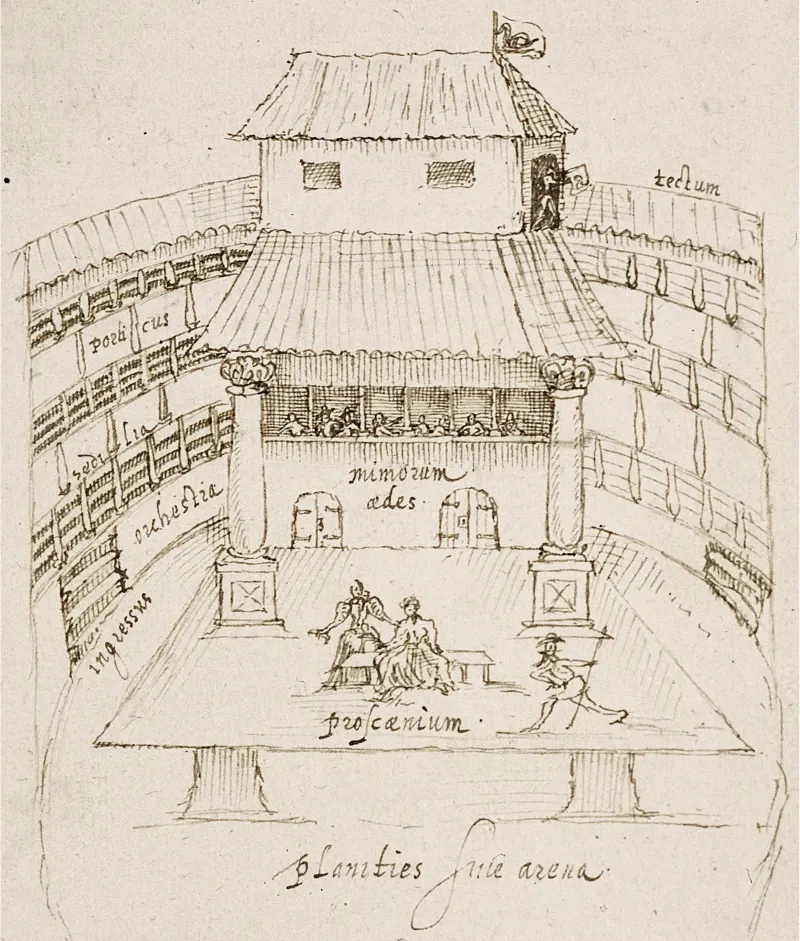
It shows a stage jutting into the yard, two doors at the back, three levels of galleries and a flag with a swan on it. As the Map of Early Modern London points out, a copy is second-hand evidence, and how far to trust it has been argued about for decades. R. A. Foakes warned against relying on it, while John Gleason argued in 1981 that it is more reliable than critics had assumed.
In 1597 the Swan staged The Isle of Dogs, a lost play by Thomas Nashe and Ben Jonson. Jonson and two actors were jailed, and the Privy Council halted playing around London until October. Whether that play caused the shutdown is usually assumed, but it can't be proved.
By 1632 a pamphlet called Holland's Leaguer described the decaying Swan as "like a dying Swanne, hanging downe her head". The site is on Hopton Street, SE1, and has never been excavated.
The Fortune, Cripplegate (1600)
Henslowe and his business partner Edward Alleyn hired Peter Street to build the Fortune, just outside the City near Golden Lane. The contract, dated 8 January 1599/1600, survives. It reads like a builder's specification: £440, finished by 25 July, square (80 feet across outside), with carved satyrs on the posts.
It also keeps pointing back to Street's previous job. The Fortune was to be built in "the manner and fashion of the saide howse Called the Globe". It burned down in December 1621, when John Chamberlain called it "the fairest playhouse in this town", and was rebuilt on the same spot.
The site is on what is now Fortune Street, between Golden Lane and Whitecross Street. No archaeological trace of it has been found.
The Hope, Bankside (1614)
In August 1613, weeks after the Globe fire, Henslowe and his partner Jacob Meade signed a contract with the carpenter Gilbert Katherens. The new building, the Hope, was to match the Swan in shape and size, down to its staircases. It had to work for plays and for bear- and bull-baiting, so the stage sat on trestles and could be removed on baiting days.
It opened in 1614, and Ben Jonson's Bartholomew Fair was first performed there on 31 October that year. The baiting won. The actors left in 1617, and Historic England says the building was dismantled in 1656.
MOLA has found brick foundations that Historic England considers very likely to be the Hope's, from a ten-sided building about 16 metres across inside. They lie under the car park on the south side of Riverside House, 2A Southwark Bridge Road, SE1.
The bear gardens
Bear- and bull-baiting rings stood on Bankside from about 1540 until 1682, which is where the street name Bear Gardens comes from. In January 1583 the stands collapsed during a baiting. Historic England says seven people died; the Survey of London says eight.
Digs nearby found large numbers of horse and dog bones, some from big mature dogs, which Historic England says may be dead fighting dogs. Samuel Pepys went to the last of the rings in the 1660s, and twice it was so crowded that he got in through the alehouse next door.
How much did a ticket cost?
At the Globe, standing in the yard cost a penny, and the galleries cost more. William Lambarde described the same system for other venues, including the Theatre. You paid "one penny at the gate, another at the entry of the scaffold, and the third for a quiet standing".
The Map of Early Modern London estimates that the original Globe could hold around 3,000 people.
Timeline: London's playhouses, 1567-2019
- : John Brayne sets up the Red Lion in Whitechapel.
- : James Burbage's lease on the Theatre's ground begins. Historic England dates its opening to 1 August 1577.
- : the Curtain is open.
- : stands collapse at the Bankside bear garden.
- : Philip Henslowe and John Cholmley build the Rose.
- : Henslowe records "harey vj" at the Rose.
- : the Swan is built in Paris Garden.
- : Burbage buys rooms at Blackfriars, and his neighbours petition against him.
- : the Theatre's lease runs out. The Isle of Dogs at the Swan leads to arrests.
- : demolition of the Theatre begins.
- : the Globe is built on Bankside from the Theatre's timbers.
- : Henslowe and Alleyn build the Fortune.
- : the Rose is called "the late playhouse".
- : the King's Men lease the Blackfriars.
- : the Globe burns down during Henry VIII.
- : the second Globe is open by 30 June. At the Hope, Jonson's Bartholomew Fair is first performed on 31 October.
- : the Fortune burns and is rebuilt.
- : Parliament orders stage plays to stop.
- : the second Globe is pulled down, according to a single handwritten note. Houses stand on the site by 1655.
- : the Hope is dismantled, according to Historic England.
- : the last Bankside bear garden is demolished.
- : the Rose's foundations are found, then the Globe's in October.
- : Shakespeare's Globe opens with Henry V, one street nearer the river than the original. The Queen formally opens it in June.
- : MOLA uncovers part of the Theatre.
- : the main excavation at the Curtain shows it was rectangular.
- : a timber structure that may be the Red Lion is found in Whitechapel.
Seeing the sites today
The Bankside sites sit close together. From Shakespeare's Globe you can walk to the Rose at 56 Park Street, the Globe's paving marker on Park Street, the Hope under Riverside House and the street called Bear Gardens. Our Shakespeare walking tour of London links them with the rest of Shakespeare's London.
Shoreditch is a separate trip north of the river. The Theatre and the Curtain are both just off Curtain Road.
Sources and further reading
- Historic England: The Theatre, Shoreditch (list entry 1433271)
- Historic England: The Curtain playhouse (list entry 1463328)
- Historic England: The Hope playhouse and Bankside bear gardens (list entry 1433280)
- Historic England: The Globe playhouse (list entry 1012806)
- MOLA: The Curtain playhouse
- Shakespeare Documented (Folger): Allen v. Burbage
- Shakespeare Documented (Folger): Henslowe's diary
- Shakespeare Documented (Folger): the 1596 Blackfriars petition
- Shakespeare's Globe: The Globe
- Shakespeare's Globe: The third Globe
- Shakespeare's Globe: "This wooden O", the history of our unique shape
- The Rose Playhouse: rediscovery
- The Rose Playhouse: guided tours
- Survey of London vol. 22, Bankside (British History Online)
- Map of Early Modern London: the Globe
- REED: the Swan playhouse
- Map of Early Modern London: the Swan
- Vic Keegan's Lost London column on the Blackfriars theatre, OnLondon (2019)
- Henslowe-Alleyn Digitisation Project: the contract for the Fortune playhouse
- UCL: Archaeologists may have discovered London's earliest playhouse (2020)
- Gabriel Egan on the Rose and Globe excavations (Early Modern Literary Studies)
- Joseph Quincy Adams, Shakespearean Playhouses (1917), Project Gutenberg
Read the Plays
Test Your Knowledge
Think you know your Shakespeare? Put it to the test with one of our free quizzes.
See all quizzes →