Globe Theatre Flags: What the Evidence Shows
You may have read that the Globe flew a white flag for a comedy, a black one for a tragedy and a red one for a history. We went looking for evidence from Shakespeare's time and found none. What the records do show is simpler. A flag over a playhouse told London there was a play on.
For where the Globe and its rivals actually stood, and what is on each site now, see Where Were Shakespeare's Theatres?.
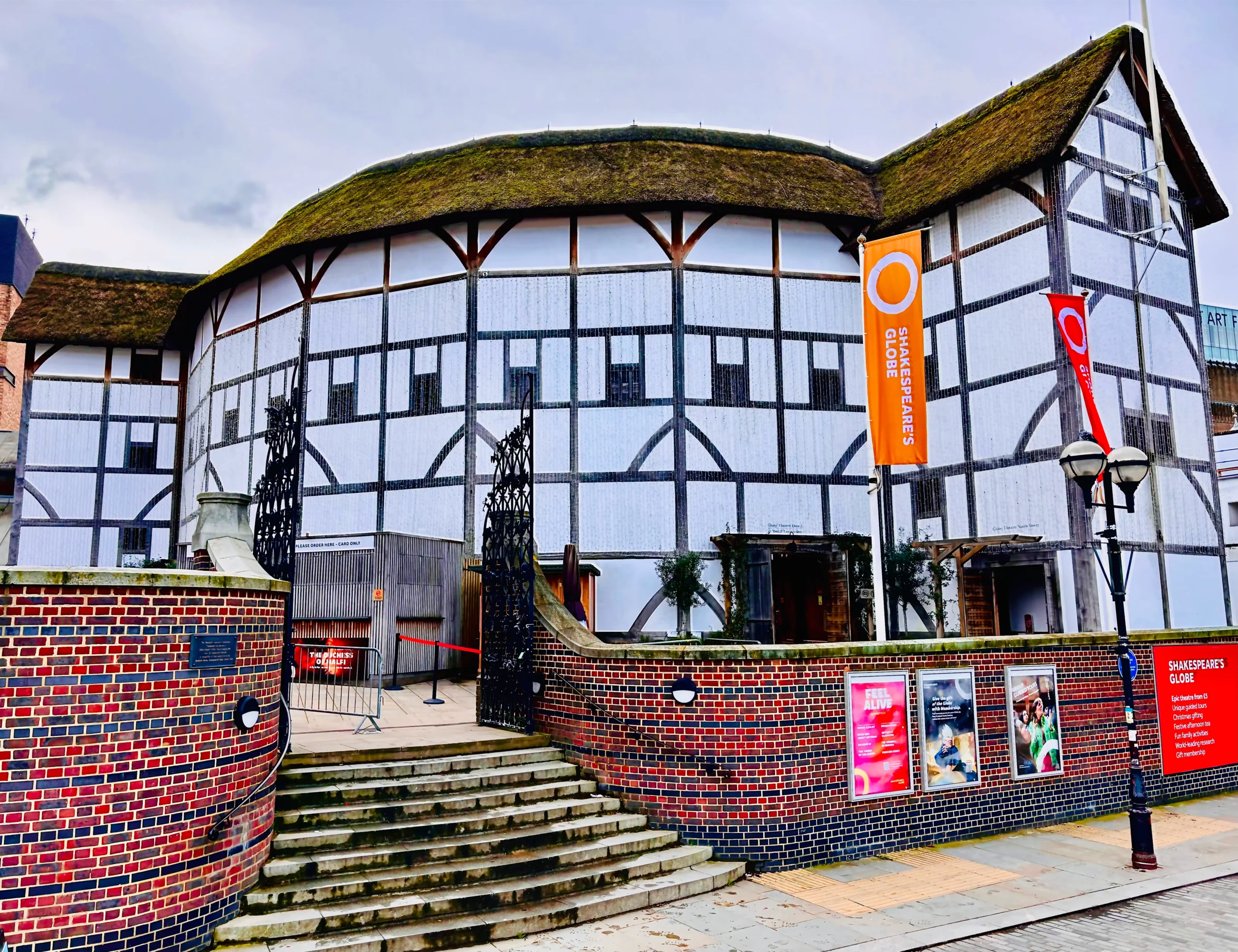
What a playhouse flag meant
Public playhouses had a flagpole above the "heavens", the roof that covered the stage. Joseph Quincy Adams, in Shakespearean Playhouses (1917), says Philip Henslowe's diary shows the Rose had one, and he describes the Curtain the same way.
The flag was advertising. Adams contrasts the indoor Blackfriars hall, used at first by boy actors, with the public playhouses, whose shows were "heralded by a trumpet-and-drum procession through the street, by the flying of a flag, and by such-like vulgar advertising as of a public show". ShakespeareGo's reading is that "vulgar" here means aimed at ordinary people, not rude.
So if you lived in London and saw a flag up over Bankside, you knew a play was on that day. That much is solid. What the flag looked like is harder.
Flags in the old pictures
You can see playhouse flags in pictures from the period. The well-known drawing of the Swan, from about 1596, shows a turret with a flag bearing a swan. It is Arend van Buchel's copy of a lost sketch by the Dutch visitor Johannes de Witt.
Claes Visscher's view of London, published in 1616, shows two tall Bankside arenas with flags, one labelled "The Globe". Adams treated that building as the first Globe, but the Folger Shakespeare Library says Visscher was probably never in London and was likely working from older pictures, so it is a doubtful portrait.
Adams also reproduces a building with a flag from the so-called Ryther map of London, drawn about 1630-40, which he thought may mark the Fortune. None of these pictures tells you a flag's colour.
Where does the colour code come from?
We don't know. The only page we found that repeats the white, black and red code is a 2003 post on the Flags of the World forum, and it gives no source. Nothing from the period that we read mentions colours at all.
You'll also see it claimed that colour flags were needed because most people couldn't read. We found no source that makes that argument from evidence. If you know of an early source for the colour code, we'd like to hear about it.
Hercules and the Globe's motto
Adams writes that a sign of Hercules carrying the globe on his shoulders hung in front of the Globe's main door. He reads a joke in Hamlet as a nod to it. Hamlet asks whether the boy actors are winning, "Do the boys carry it away?", and Rosencrantz answers: "Ay, that they do, my lord; Hercules and his load too." (Act 2, Scene 2).
Some websites put Hercules on the flag instead. The Internet Shakespeare Editions says the Globe's flag showed him with the world on his shoulders, but gives no source, and Adams calls it a sign over the door.
Then there's the Latin motto, Totus mundus agit histrionem, roughly "the whole world plays the actor". Adams took it from the editor Edmond Malone, writing long after the Globe had gone. The theatre historian Tiffany Stern questioned it in a 1997 article in Theatre Notebook, and the title asks whether it was ever the motto of the Globe at all.
Sources and further reading
- Joseph Quincy Adams, Shakespearean Playhouses (1917), Project Gutenberg
- Tiffany Stern, "Was Totus Mundus Agit Histrionem ever the motto of the Globe Theatre?", Theatre Notebook 51 (1997), Royal Holloway research record
- REED: the Swan playhouse
- Map of Early Modern London: the Swan
- Visscher's 1616 view of London, Wikimedia Commons
- Internet Shakespeare Editions: the Globe
- Hamlet, Act 2, Scene 2, MIT Shakespeare

White Flag — Comedy
White, the colour of purity and happy endings, told crowds to expect laughter, romance and a joyful finale.
Black Flag — Tragedy
Black, the hue of mourning, foreshadowed death, sorrow and weighty themes — think Hamlet or Macbeth.
Red Flag — History
Red, associated with blood and battle, signalled a history play filled with kings, crowns and sword-clashing patriotism.
Explore Shakespeare's Plays by Genre
Now you know how flags signalled comedies, tragedies and histories — dive into the plays themselves!
🎭 Browse All PlaysRead the Plays
Test Your Knowledge
Think you know your Shakespeare? Put it to the test with one of our free quizzes.
See all quizzes →